Carlos installed the cameras with the precision he once reserved for billion-dollar contracts, convincing himself this was responsibility, not paranoia.
He told himself a father had the right to understand what healed his child when money, doctors, and power had all failed.
The first hours showed nothing extraordinary, only the ordinary rhythm of a house finally breathing again.
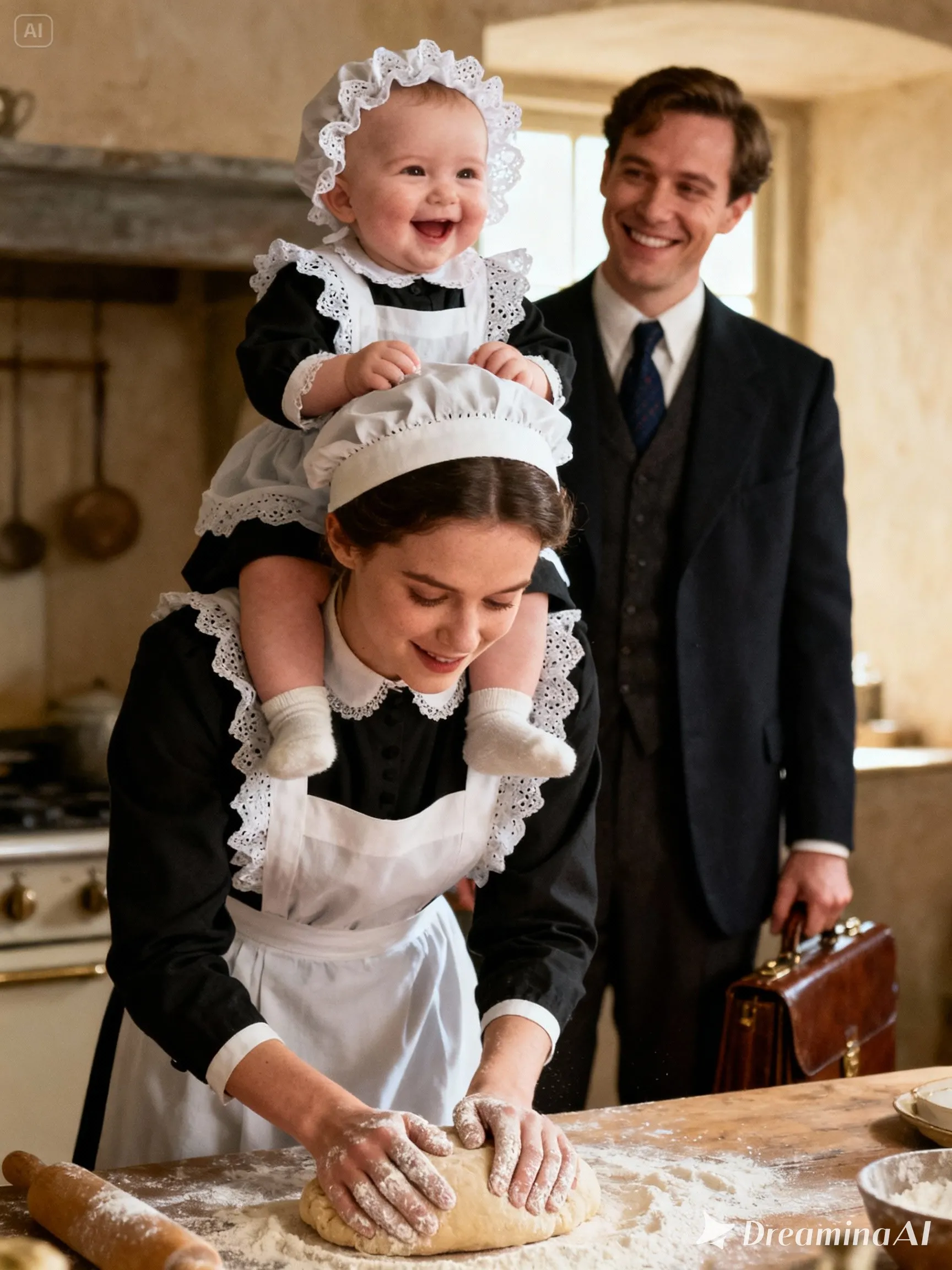
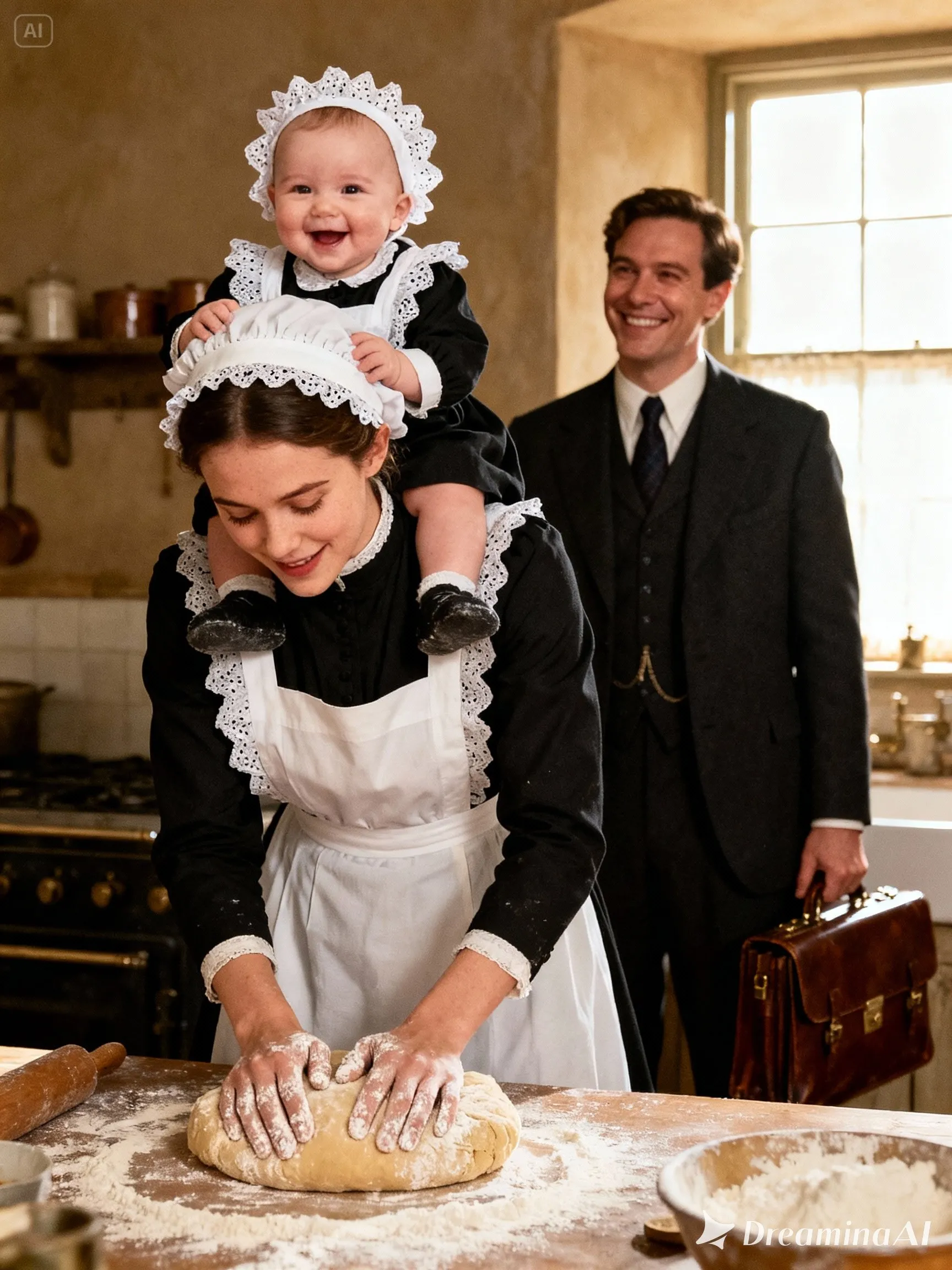
Carmen cleaned, cooked, hummed softly, and spoke to Valentina as if the world had never broken them.
Carlos watched from his office, heart pounding, as his daughter followed the maid like a small shadow.
There were no commands, no pressure, only invitations disguised as play.
Carmen never asked Valentina to speak, never demanded answers, never corrected her silence.
She spoke around her, to her, with her, creating space rather than expectations.
When Valentina spilled water, Carmen laughed instead of scolding.
When plates broke, Carmen turned accidents into stories, not mistakes.
Carlos felt something unfamiliar tightening his chest.
In his world, mistakes were punished, corrected, or erased with money.
Days passed, and Valentina’s voice grew stronger, fuller, more confident.
She spoke in fragments first, then sentences, then songs Carlos remembered from her mother.
Each word felt like both a miracle and an accusation.
Why had this warmth succeeded where his desperate love had failed.
Online debates would later explode over this very question.
Was healing about resources, or about presence stripped of power.
One afternoon, Carmen sat on the floor, letting Valentina braid her hair with clumsy fingers.
She winced softly when tugged, teaching patience without ever naming it.
Carlos replayed the footage repeatedly, searching for a trick, a secret method, a hidden technique.
There was none, only consistency and gentleness.
The cameras captured something else too.
Carmen spoke often about Daniela, not avoiding her name, not whispering it like forbidden knowledge.
She told Valentina stories of her mother laughing, cooking, singing, and loving fiercely.
She normalized grief instead of sealing it behind silence.
Carlos realized, with growing discomfort, that he had tried to protect his daughter by erasing pain.
In doing so, he had erased conversation, memory, and connection.
That night, social media would later argue endlessly over his next decision.
Some would call it betrayal, others long-overdue humility.
Carlos confronted Carmen the following evening, unable to contain his turmoil.
She stood still, hands folded, eyes steady, expecting dismissal or punishment.
Instead, he asked a question no employee had ever heard from him.
“How did you do it?”
Carmen hesitated, then spoke carefully, aware of the imbalance between them.
“I didn’t do anything,” she said, voice quiet but firm.
“I just stayed,” she continued.
“I didn’t try to fix her.”
The words hit Carlos harder than any accusation.
He had spent months trying to fix what only needed to be felt.
Public reaction later would split sharply along familiar lines.
Some would accuse Carmen of overstepping boundaries.
Others would accuse Carlos of emotional negligence masked by wealth.
The comment sections would burn with projection, class resentment, and personal trauma.
Carlos made a controversial choice the next day.
He removed the cameras and apologized.
That apology, unseen but pivotal, marked the true turning point.
Power had finally stepped aside to make room for trust.
He asked Carmen to stay, not as staff, but as a constant presence in Valentina’s life.
The offer came with boundaries, respect, and autonomy.
Critics would later argue this blurred lines dangerously.
Supporters would argue healing rarely respects hierarchy.
Carlos began changing too, though awkwardly at first.
He sat on the kitchen floor.
He washed dishes badly.
He listened without interrupting.
Valentina did not rush back to him.
She approached cautiously, testing whether his love could exist without control.
When she finally spoke to him again, it wasn’t dramatic.
It was simple.
“Daddy, stay.”
Those two words shattered the man more than losing billions ever could.
They became the most shared quote when the story later surfaced online.
Months later, when Carlos quietly funded a foundation focused on childhood grief, the internet noticed.
Speculation exploded about motives, guilt, redemption, and performative charity.
Carmen refused interviews.
Valentina was protected from exposure.
That silence only fueled fascination.
People wanted heroes and villains, but found neither clearly defined.
The story spread because it touched a nerve modern society avoids.
The idea that love without dominance can be revolutionary.
Commentators debated whether wealth corrupts empathy or merely amplifies absence.
Psychologists weighed in on grief, attachment, and emotional safety.
Parents questioned their own instincts.
Workers questioned invisible labor and emotional contribution.
The billionaire became a symbol, not of money, but of unlearning.
The maid became a symbol, not of servitude, but of presence.
What unsettled audiences most was not the miracle of Valentina speaking again.
It was the implication that power often delays healing.
The story refused neat conclusions.
There was no punishment, no triumph, no viral confession video.
Only a house that finally felt alive again.
Only a child laughing without fear.
And a man learning, too late but not too late enough, that love cannot be outsourced, commanded, or bought.
That realization, quietly radical, is why the story continues to resurface.
Because it asks a question many would rather ignore.
What if the thing we control the most is exactly what needs to let go.
In the weeks that followed, rumors escaped the mansion despite Carlos’s efforts to contain them.
Staff noticed changes, fewer orders, more questions, longer pauses before decisions.
Some executives whispered that grief had weakened him.
Others suspected a calculated rebranding of his public image.
Neither explanation captured the truth unfolding quietly behind closed doors.
Carlos was relearning how to exist without authority filling every silence.
At dinner, he waited for Valentina to choose where to sit.
When she chose Carmen, he swallowed disappointment and stayed present.
This restraint became the most difficult discipline of his life.
The internet, had it known, would have torn him apart for it.
One evening, Valentina asked a question that froze both adults.
“Why didn’t Mommy come back?”
Carmen did not rush to answer.
Carlos did not interrupt.
Together, they let the truth exist without decoration or avoidance.
That night, Valentina cried for the first time since the accident.
Not quietly, not politely, but fully, violently, honestly.
Carlos held her without promising fixes.
This moment, more than any boardroom victory, redefined success for him.
Healing, he realized, was not progress, but permission.
When the story eventually leaked online, reactions were predictably divided.
Some praised emotional growth.
Others accused Carlos of emotional outsourcing and blurred class boundaries.
Debates raged over whether Carmen’s role was nurturing or intrusive.
Few agreed, which only amplified sharing.
The story lived because it resisted moral simplicity.
Think pieces emerged about invisible labor and emotional intelligence.
Critics questioned why tenderness is often dismissed until it saves something valuable.
Carlos never responded publicly.
His silence became part of the narrative.
In a culture obsessed with statements, silence felt suspicious.
Yet it was the only response that felt honest.
Valentina returned to school months later, quieter than before, but present.
She carried grief without hiding from it.
Carmen remained, not as savior, but as witness.
And Carlos learned that witnessing is sometimes the bravest act available.
The story continues to resurface because it refuses to tell us who to admire.
Instead, it asks who we are when control no longer works.
That question lingers longer than any headline.
And perhaps that is why people keep sharing it.
Part 2: The Cracks in the Porcelain
The cameras were gone, but the scrutiny was only beginning. While Carlos was busy unlearning the language of command within the walls of his mansion, the world outside was sharpening its knives. A billionaire’s sudden retreat from the cutthroat rhythm of industry doesn’t go unnoticed—it looks like blood in the water.
The Corporate Counter-Strike
While Carlos sat on the kitchen floor learning to braid Valentina’s hair, the board of directors at Valdez Global was meeting in a room made of glass and ice.
“He’s compromised,” the Chief Operating Officer whispered, sliding a tabloid across the table. The headline read: VALDEZ VAGUELY PRESENT: Billionaire Abandons Boardroom for the Nursery. To the men who measured life in quarterly growth, Carlos’s silence wasn’t healing; it was a dereliction of duty. They launched a quiet but brutal coup, leveraging his emotional absence to move for a vote of “no confidence.”
The drama hit Carlos on a Tuesday, while he and Carmen were helping Valentina plant a memorial garden for Daniela. His phone, which he had promised to ignore, buzzed incessantly. Finally, he answered.
“They’re taking the company, Carlos,” his lawyer said, voice tight. “They’re using your ‘domestic instability’ as proof that you’ve lost your grip. If you don’t show up at the summit tomorrow and act like the shark they know, you lose everything.”
The Choice of Two Deaths
That night, the mansion was heavy with an old, familiar tension. Carlos stood in his study, looking at the suit he hadn’t worn in weeks. He could feel the old armor calling to him—the power, the control, the ability to crush his enemies with a single signature.
But then he heard laughter.
It was faint, coming from the hallway. Valentina was telling Carmen a joke. Not a song, not a repeated phrase, but a genuine, messy, spontaneous joke.
If he went to the summit, he would have to become the man who erased pain to ensure “efficiency.” He would have to leave the garden half-planted. He would have to remind Valentina that her father’s time was a commodity she couldn’t afford.
“You’re going, aren’t you?”
He turned to see Carmen standing in the doorway. She wasn’t holding a tray or a cleaning rag. She was just… there.
“I have to protect her future, Carmen,” Carlos said, his voice pleading for justification. “If I lose the company, the foundation, the security, the life I built for her—what does she have left?”
Carmen stepped into the room, her presence grounding the swirling chaos of his mind. “She has a father who stays,” she said softly. “You can buy her a thousand futures, Carlos. But you only have one ‘now.’ If you go back to being a shark, you’ll come home to a ghost. And this time, it won’t be her silence that haunts you. It will be yours.”
The Summit of Silence
The following day, the Valdez Global boardroom was packed. The air was thick with the scent of expensive cologne and predatory intent. The COO sat at the head of the table, ready to finalize the ouster.
The doors swung open. Carlos walked in.
He wasn’t wearing the power tie. He wasn’t carrying a briefcase. He looked like a man who had slept six hours and spent four of them thinking.
He didn’t scream. He didn’t threaten. He sat down and let the board members air their grievances for thirty minutes. He listened—really listened—the way Carmen had taught him to listen to Valentina.
When they finished, he spoke.
“You say I’ve lost my grip because I’m prioritizing a child’s grief over a merger,” Carlos said, his voice calm but terrifyingly heavy. “I say I’ve finally found my grip. I spent years building a company that operates on fear and erasure. I’m done. If you want a CEO who values power over presence, then vote me out. But know this: I’m taking my shares, my patents, and my name with me. I’d rather be a father with nothing than a billionaire with a broken home.”
The room went ice-cold. For the first time in the company’s history, Carlos wasn’t negotiating. He was surrendering his ego, and in doing so, he became untouchable.
The Viral Truth
The board didn’t vote him out. They couldn’t afford the collapse of the brand. But the story of the “Surrendered Billionaire” leaked.
The internet went into a frenzy.
-
“He’s manipulative,” some tweeted. “It’s a PR stunt to look relatable.”
-
“He’s weak,” others argued. “The maid has brainwashed him.”
But then, a photo surfaced. It wasn’t a professional shot. It was a grainy, long-lens photo taken by a neighbor. It showed Carlos, Carmen, and Valentina sitting in the dirt of the garden. Carlos was covered in mud, laughing as Valentina dumped a bucket of water on his shoes. Carmen was in the background, a quiet witness to a man finally learning to breathe.
The Epilogue: The Cost of Peace
Carlos did step back eventually. He appointed a new CEO and focused his life on the foundation. He never married Carmen—critics would have called it a cliché, and the reality was more complex. Their bond wasn’t built on romance, but on a shared understanding of what it means to hold a broken thing until it knits back together.
Years later, when Valentina graduated, she was asked in an interview about the “Maid who saved her.”
Valentina corrected the reporter with a smile that reached her eyes.
“Carmen didn’t save me,” Valentina said. “She just sat with me in the dark until I wasn’t afraid to turn on the light. And my father? He didn’t find me. He let himself be lost until we could find each other.”
The story of the Billionaire and the Maid remains a lightning rod for debate. People still argue about class, about money, and about the “proper” way to heal.
But inside the mansion, the cameras are never coming back. The dishes are still being broken occasionally. The garden is in full bloom. And Carlos Valdez finally knows that the only thing worth controlling is the urge to control at all.
The power was gone. The peace remained.